

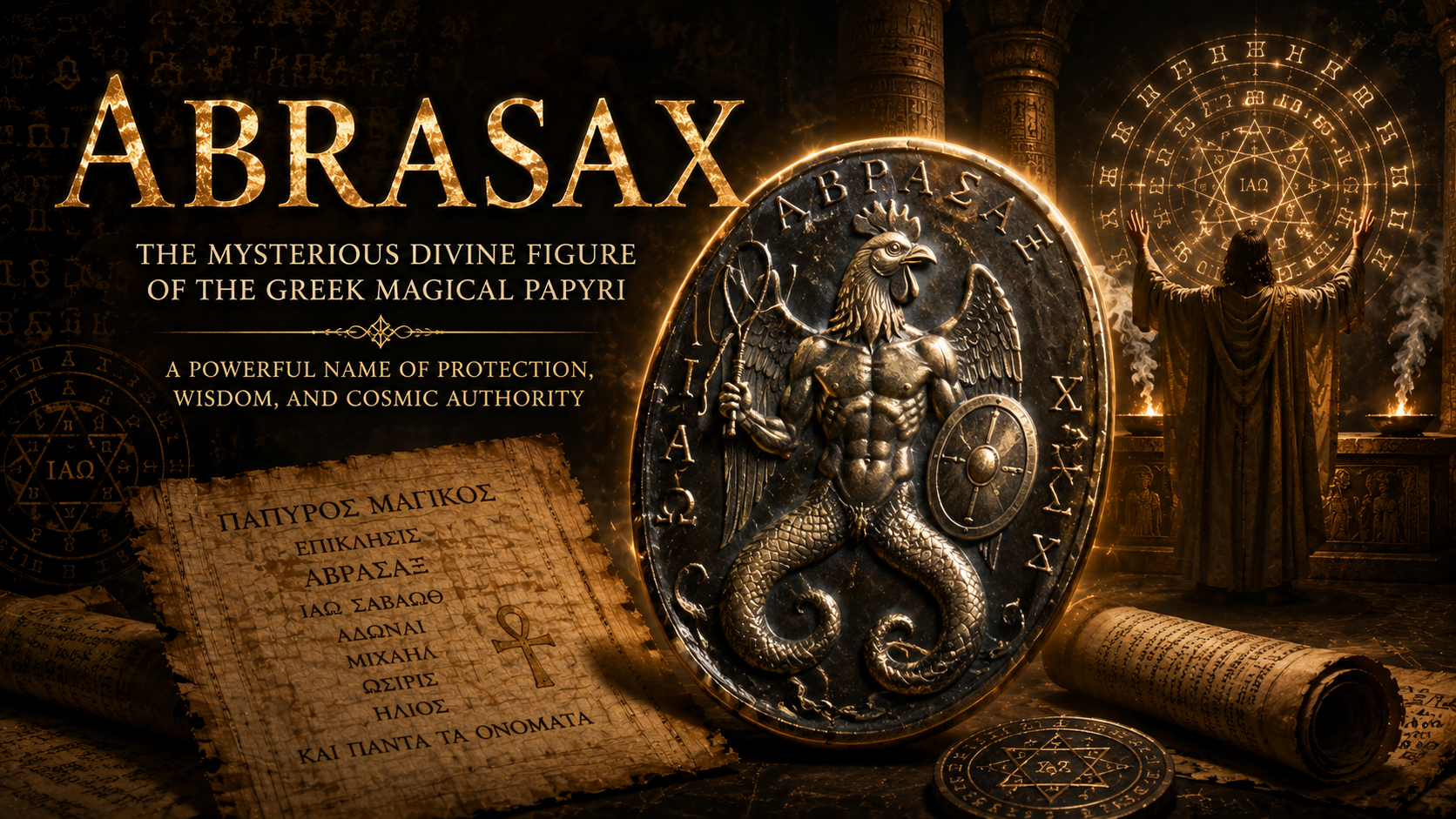
Abrasax, more commonly spelled Abraxas, is one of the most mysterious figures to emerge from the religious and magical traditions of the ancient Mediterranean. His name appears in Gnostic writings, magical gemstones, and the Greek Magical Papyri (PGM), where it functions as both a powerful divine name and a symbol of cosmic authority.
Unlike the familiar gods of Greece or Egypt, Abrasax occupies a unique place at the intersection of religion, philosophy, and ceremonial magic. Ancient practitioners associated his name with protection, divine power, and mastery over the heavens, while Gnostic traditions viewed him as a transcendent cosmic being connected with the structure of the universe itself.
Today, Abrasax remains one of the best-known figures in ancient esotericism and continues to fascinate historians, collectors, and students of Western occult traditions.
Who Is Abrasax?
Abrasax is a divine figure whose name appears in several ancient religious traditions.
He is most strongly associated with Gnosticism, especially the teachings attributed to Basilides. According to later reports, Basilides described Abrasax as a supreme heavenly power associated with the creation and governance of numerous celestial realms.
Outside Gnosticism, the name appears frequently in magical texts, engraved gemstones, and protective amulets throughout the Roman Empire.
Although scholars continue to debate his precise origins, Abrasax became one of the most recognizable names in ancient magical practice.
Abrasax in the Greek Magical Papyri
The Greek Magical Papyri preserve numerous invocations that include the name Abrasax.
Within these rituals, his name is invoked alongside other sacred names such as:
- Iao
- Sabaoth
- Adonai
- Michael
- Helios
- Osiris
Rather than serving as the central figure of an independent mythology, Abrasax functions as a source of divine authority whose name was believed to strengthen magical rituals.
The PGM includes spells for:
- Protection
- Healing
- Divine revelation
- Dream magic
- Spirit communication
- Exorcism
- Success in legal matters
Abrasax appears in several of these traditions as one of the powerful names spoken during ritual invocations.
Meaning of the Name Abrasax
One of the most famous theories concerning Abrasax involves Greek numerology.
Using the Greek system of assigning numerical values to letters:
| Letter | Value |
|---|---|
| Α | 1 |
| Β | 2 |
| Ρ | 100 |
| Α | 1 |
| Σ | 200 |
| Α | 1 |
| Ξ | 60 |
The total equals 365.
Ancient writers connected this number with:
- The days of the solar year
- The complete cosmos
- The celestial spheres
- Universal divine authority
Although historians cannot confirm whether this numerical meaning inspired the name or developed later, the association became highly influential.
Appearance
The most famous image of Abrasax appears on engraved magical gemstones.
He is typically depicted with:
- The head of a rooster
- The body of a muscular man
- Two serpents instead of legs
- A whip in one hand
- A shield in the other
Each feature likely carried symbolic meaning.
| Feature | Possible Symbolism |
|---|---|
| Rooster | Sunrise, vigilance, divine light |
| Serpent Legs | Wisdom, eternity, renewal |
| Whip | Authority and cosmic power |
| Shield | Protection |
Because these meanings are inferred from comparative symbolism, they should not be treated as explicit ancient explanations.
Abrasax Gems
Thousands of engraved gemstones depicting Abrasax have survived.
Known today as Abrasax gems, these amulets were typically carved from stones such as:
- Jasper
- Carnelian
- Hematite
- Chalcedony
Many combine the image of Abrasax with magical words, divine names, planetary symbols, or protective inscriptions.
These gems were worn for:
- Protection
- Good fortune
- Healing
- Spiritual authority
They represent one of the richest archaeological sources for the study of ancient magic.
Was Abrasax a God?
The answer depends on the historical context.
Within Gnostic traditions, Abrasax appears as a powerful divine being associated with the structure of the heavens.
Within the Greek Magical Papyri, however, his name functions primarily as a sacred divine name invoked during ritual practice.
For this reason, scholars often describe Abrasax as a Gnostic divine figure, cosmic power, or magical being rather than simply labeling him a Greek or Egyptian god.
Historical Origins
The precise origin of Abrasax remains uncertain.
Scholars have proposed influences from:
- Egyptian religion
- Greek philosophy
- Jewish mystical traditions
- Gnosticism
- Roman magical practice
Most agree that Abrasax emerged within the culturally diverse religious environment of Roman Egypt during the early centuries AD.
Abrasax in Modern Culture
The image of Abrasax continues to appear in:
- Fantasy literature
- Video games
- Occult symbolism
- Modern esoteric traditions
- Jewelry
- Academic studies of Gnosticism
His distinctive rooster-headed form has become one of the most recognizable symbols of ancient magical religion.
Historical Sources
Primary historical evidence comes from:
- The Greek Magical Papyri (PGM)
- Gnostic writings associated with Basilides
- Ancient magical gemstones
- Early Christian writers such as Irenaeus, who described Basilidean teachings
Frequently Asked Questions
Is Abrasax the same as Abraxas?
Yes. Abraxas is the more common modern spelling, while Abrasax also appears in ancient sources. Both refer to the same figure.
Is Abrasax a Greek god?
No. Abrasax is generally understood as a Gnostic divine figure and magical name rather than one of the traditional gods of Greek mythology.
Why is Abrasax associated with 365?
The Greek numerical values of the letters in his name add up to 365, corresponding to the days of the solar year.
What does Abrasax look like?
Ancient gemstones depict him with a rooster’s head, a human torso, serpent legs, a whip, and a shield.
Where is Abrasax mentioned?
He appears in the Greek Magical Papyri, Gnostic traditions associated with Basilides, ancient magical gemstones, and the writings of early Christian authors discussing Gnostic beliefs.
Abrasax stands among the most fascinating figures in ancient esotericism. Appearing in Gnostic traditions, magical gemstones, and the Greek Magical Papyri, he embodies the blending of religion, philosophy, and ritual magic that characterized Roman Egypt.
Whether viewed as a cosmic ruler, a divine name of power, or a symbol of universal authority, Abrasax remains one of the most enduring and recognizable figures in the history of ancient magic.