

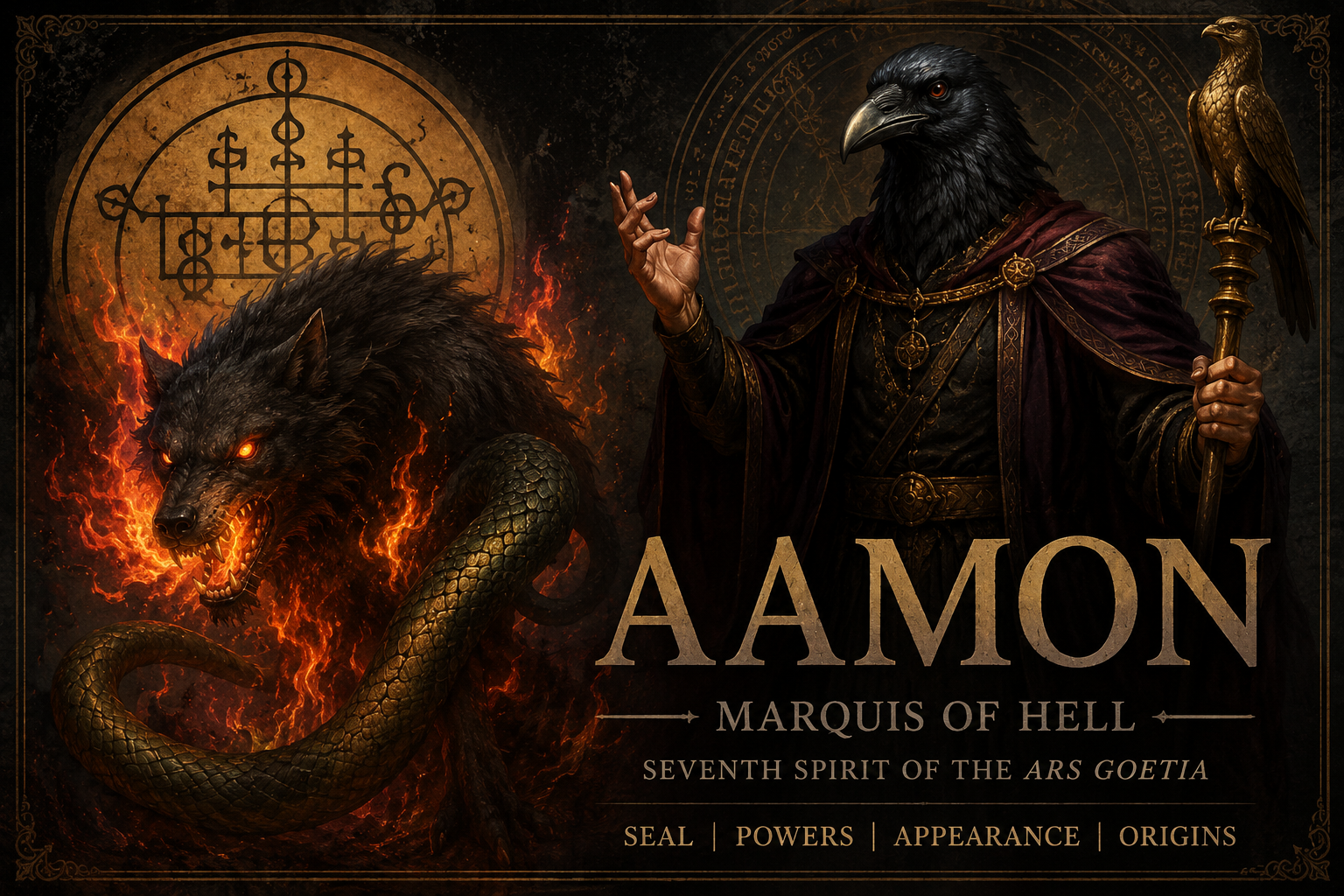
Aamon is one of the seventy-two demons described in the Lesser Key of Solomon, also known as the Ars Goetia. According to the grimoire, he holds the rank of Marquis of Hell, commands forty infernal legions, and is said to reconcile friends, reveal the past and future, and settle disputes between enemies.
Although Aamon is one of the best-known spirits in ceremonial magic, little historical evidence suggests he existed as a deity before medieval grimoires. Most scholars believe the figure evolved through centuries of religious adaptation, drawing inspiration from the ancient Egyptian god Amun while taking on an entirely different identity in European demonology.
Today, Aamon remains one of the most frequently discussed spirits within Western occult literature, ceremonial magic, and modern demonology.
Who Is Aamon?
In the Ars Goetia, Aamon is introduced as the seventh spirit.
He appears as a powerful Marquis who can answer questions about both the past and the future while helping people reconcile conflicts. Unlike many Goetic spirits whose abilities center on wealth or hidden treasure, Aamon’s reputation focuses on relationships, diplomacy, and knowledge.
His description combines several symbolic animals into one unusual form, making him one of the more visually distinctive spirits in the Goetia.
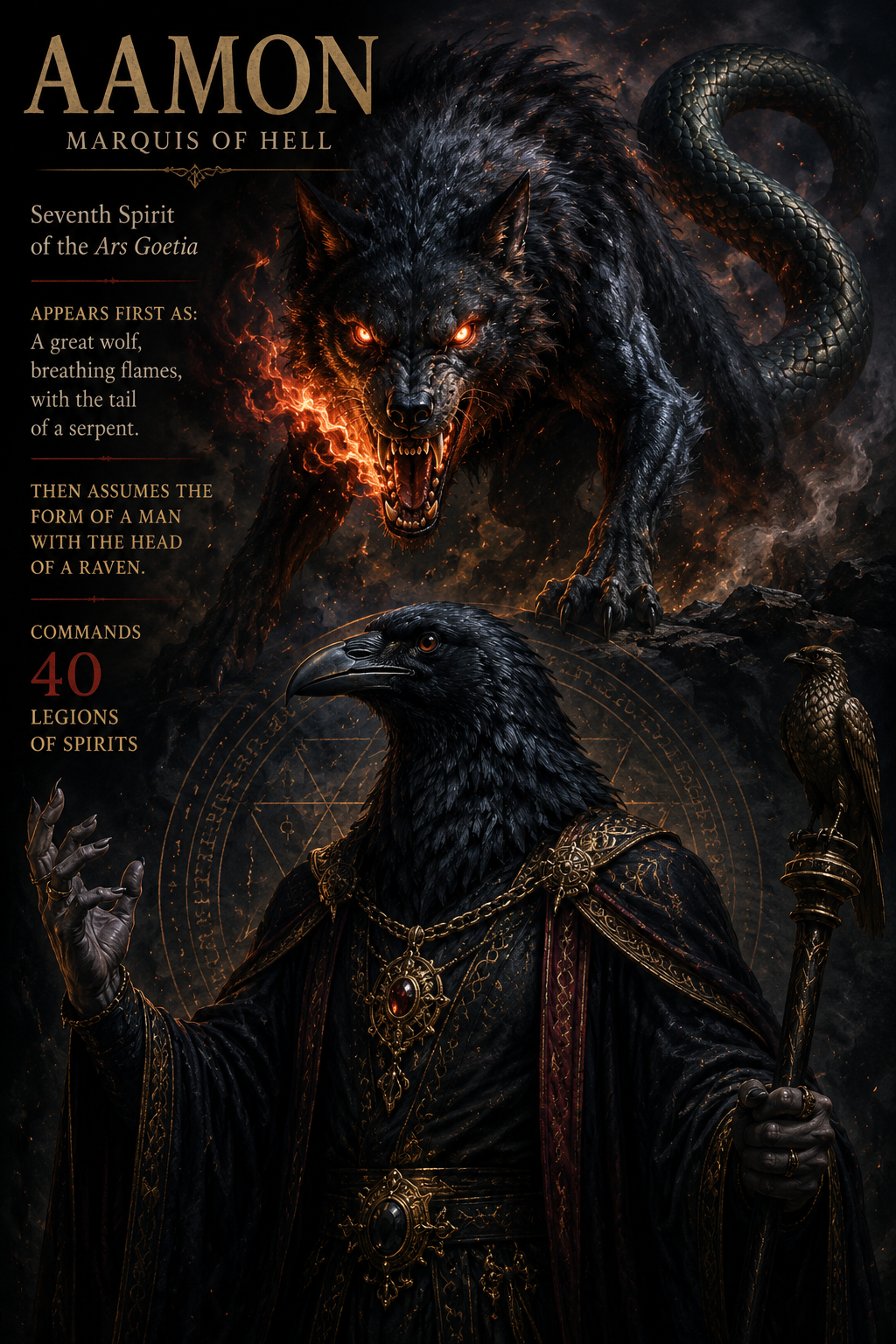
Aamon’s Description
According to the Lesser Key of Solomon, Aamon first appears as:
- A wolf
- Breathing flames
- With the tail of a serpent
When commanded by the magician, he transforms into the appearance of a man with the head of a raven, sometimes depicted with canine teeth or carrying a hawk.
This transformation symbolizes moving from primal instinct into intelligence and prophecy.
Aamon’s Seal
Every spirit in the Ars Goetia is assigned a magical seal.
Aamon’s sigil consists of elegant looping curves enclosed within a geometric framework. In ceremonial magic, practitioners traditionally drew or engraved the seal during ritual work as a symbolic representation of the spirit’s authority.
Historically, these seals were believed to identify a specific spirit rather than function as objects possessing power on their own.
Aamon’s Powers
The Ars Goetia attributes several abilities to Aamon.
Reconciling Friends
His most famous ability is restoring friendships after conflict.
Because of this reputation, modern occult writers often associate Aamon with diplomacy, forgiveness, and mediation.
Reconciling Enemies
The text also claims Aamon can reconcile enemies, ending feuds or encouraging peace between opposing parties.
Some later interpretations suggest he can also create conflict, though this ability is not emphasized in the earliest versions of the Ars Goetia.
Revealing the Past
Aamon is said to answer questions concerning events that have already occurred.
In Renaissance ceremonial magic, such knowledge was believed to come through supernatural insight rather than historical investigation.
Revealing the Future
Like several Goetic spirits, Aamon allegedly possesses prophetic knowledge of future events.
Grimoires often describe these revelations as conditional rather than absolute.
Rank and Legions
According to the Lesser Key of Solomon:
| Attribute | Description |
|---|---|
| Rank | Marquis |
| Spirit Number | 7 |
| Legions Commanded | 40 |
| Primary Grimoire | Ars Goetia |
| Specialty | Reconciliation, prophecy, knowledge |
Appearance Symbolism
Each part of Aamon’s appearance likely carries symbolic meaning.
| Feature | Possible Symbolism |
|---|---|
| Wolf | Instinct, aggression, wilderness |
| Flames | Transformation, purification, destructive power |
| Serpent Tail | Wisdom, hidden knowledge, ancient symbolism |
| Raven Head | Intelligence, prophecy, mystery |
These interpretations come from comparative symbolism rather than explicit explanations in the grimoire itself.
Origin of the Name Aamon
Many historians believe the name Aamon ultimately derives from the ancient Egyptian god Amun (also spelled Amon).
During Late Antiquity and the Middle Ages, many pagan deities were gradually reinterpreted within Christian demonology. As older religions disappeared, numerous divine figures became classified as demons in medieval literature.
Whether Aamon represents a direct transformation of Amun remains debated among scholars, but the similarity of the names is difficult to ignore.
Importantly, the Goetic demon Aamon shares virtually none of the religious role or mythology associated with the Egyptian creator god.
Aamon in the Lesser Key of Solomon
The Lesser Key of Solomon was compiled during the seventeenth century from earlier magical traditions.
Within the Ars Goetia, each spirit receives:
- A rank
- A seal
- A description
- The number of legions commanded
- Claimed supernatural abilities
Aamon follows this standard format and has remained one of the best-known spirits from the collection ever since.
Aamon in Modern Occultism
Modern practitioners of ceremonial magic interpret Aamon in different ways.
Some regard him as an actual spiritual intelligence.
Others understand him as a psychological archetype representing reconciliation, insight, or hidden knowledge.
Academic scholars generally study Aamon as part of the historical development of Western esotericism rather than as evidence of a literal supernatural being.
Aamon in Popular Culture
Because of the popularity of the Lesser Key of Solomon, Aamon has appeared in numerous works of fiction, including:
- Fantasy novels
- Horror fiction
- Video games
- Tabletop role-playing games
- Occult-inspired artwork
These portrayals often borrow his name while dramatically altering his appearance and abilities.
Historical Sources
The earliest surviving descriptions of Aamon appear in Renaissance grimoires rather than in ancient Egyptian religious texts.
Primary sources include:
- The Lesser Key of Solomon (Ars Goetia)
- Pseudomonarchia Daemonum by Johann Weyer (1563)
- Later editions of the Lemegeton
These works form the basis for nearly every modern description of Aamon.
Frequently Asked Questions
Is Aamon a fallen angel?
The Lesser Key of Solomon describes Aamon as a demon and Marquis of Hell. It does not explicitly identify him as a fallen angel.
What rank is Aamon?
He is a Marquis who commands forty legions of spirits.
What does Aamon look like?
He first appears as a fire-breathing wolf with a serpent’s tail before transforming into a man with the head of a raven.
What are Aamon’s powers?
According to the grimoire, he reveals the past and future while reconciling friends and enemies.
Is Aamon based on the Egyptian god Amun?
Many scholars believe the name derives from Amun, but the Goetic demon and the Egyptian deity have very different roles and traditions.
Aamon is one of the most recognizable spirits in the Lesser Key of Solomon. Described as a Marquis commanding forty legions, he is associated with reconciliation, prophecy, and hidden knowledge. His striking appearance, distinctive seal, and possible connection to the ancient god Amun have made him one of the most studied figures in Western demonological literature.
Whether approached as a historical curiosity, a subject of religious history, or a figure within ceremonial magic, Aamon continues to occupy an important place in the study of grimoires and Western esotericism.